The Birthday Massacre concert: 2017 tour review & new album! Sumo Cyco, Kyoto Gion kawaii shops.

Summer is back, and I’m ready to play! I have some big new destinations coming up — all will be announced soon.
If you’ve been following my Instagram Stories or Snapchat (@lacarmina), you’ll have seen me at the The Birthday Massacre live in Vancouver!
Read on for a review of the Gothic concert. I also included some snapshots from Kyoto, Japan because they remind of Rose (as I last saw this band with her in 2010.)

Greetings, Earthlings. We are now taking over your planet. (Couldn’t resist posing with the UFO spaceship “Time Top,” by Jerry Pethick.)
Before the concert, my friends and I spent the day walking by the ocean, and enjoying the sunshine that has finally hit Vancouver.
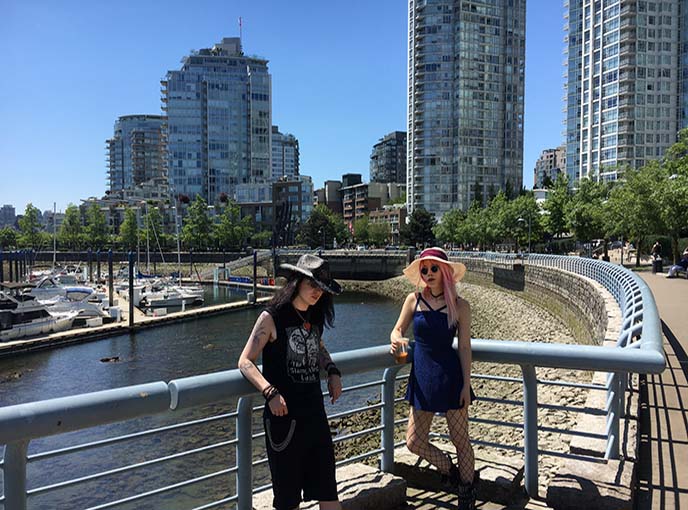
I’m shading my eyes from the light with these exact John Lennon Walrus eyeglasses (yes, he has a glasses collection!) These round, retro metal frames are based on the design that the Beatles musician wore in iconic photos.
If you can “imagine” yourself wearing John Lennon sunglasses, you can get them here.
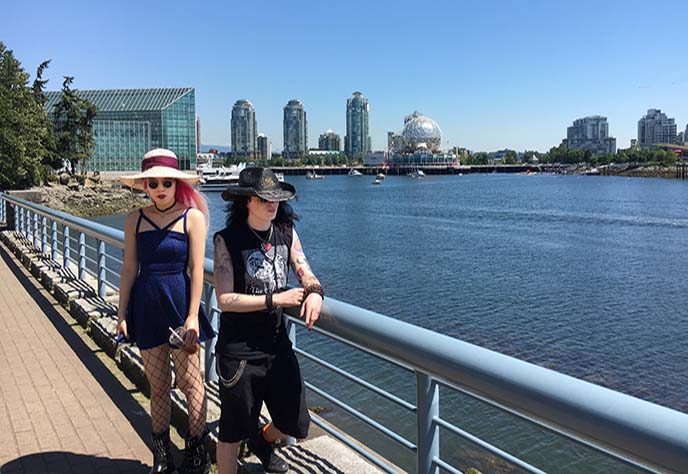
We encountered yet another alien mothership on our walk. (Okay, it’s Vancouver Science World).
– Outfit Details – I bought my dress at Siam Paragon / Discovery mall in Bangkok, Thailand.
My diamond fishnet tights are from We Love Colors. They carry a variety of colored socks and legwear (mine are the wide mesh fishnet style in navy — great for warm weather).
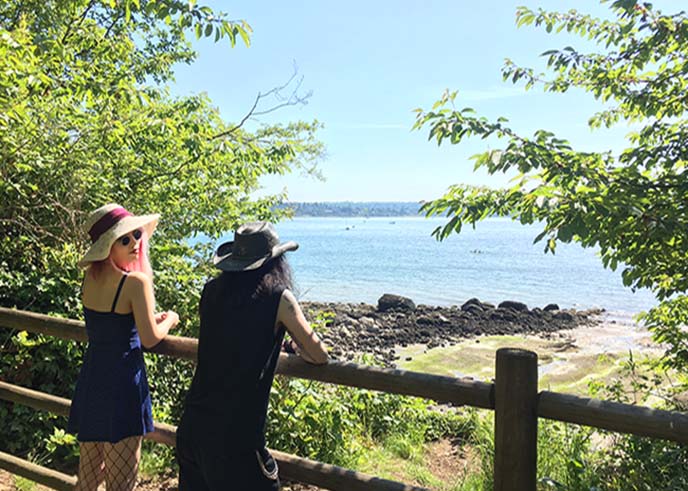
A perfect day of wandering around downtown. We stopped for dinner and cocktails, and then headed to The Venue on Granville Street for the show.

The opening act, Sumo Cyco, started the show — and stole it. The stylish lead singer Sever (or Skye Sweetnam) is impossible to take your eyes from. She tossed her blue-green hair back and forth, crouched like a tiger, and went out into the crowd to down a whiskey shot. By the end of the set, her powerful stage presence had everyone smiling and bopping along.

Sumo Cyco’s songs are a mix of punk and metal: catchy hooks and riffing guitars over heavy beats. I was impressed with Sever’s vocals, which moved from the sweetness of Gwen Stefani to a deadly growl.

My friends and I were all blown away by Sumo Cyco, and would see them live again. It’s fantastic to discover an indie, female-fronted band that rocks this hard, exceeding all expectations for an opening act.
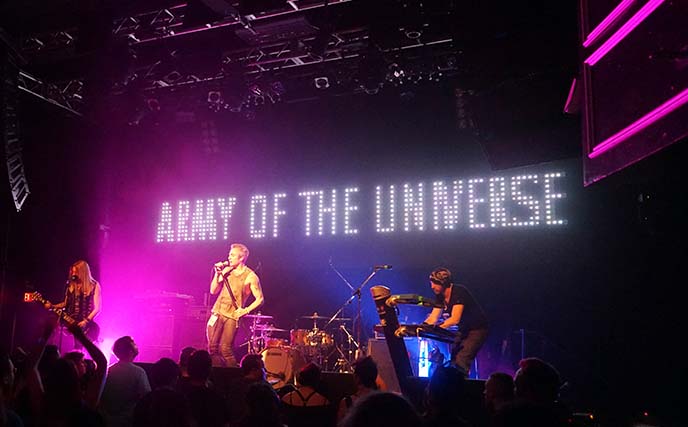
Next up: a solid performance by Army of the Universe. This industrial dance music group hails from Italy, and is signed to the Metropolis Records.
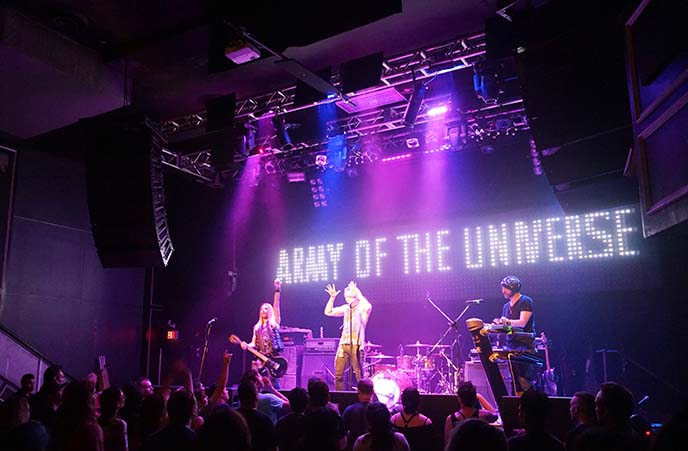
I’m often reminiscing about the 1990s these days… Army of the Universe spoke to my nostalgia, with an electro-techno industrial rock sound reminiscent of early Nine Inch Nails.
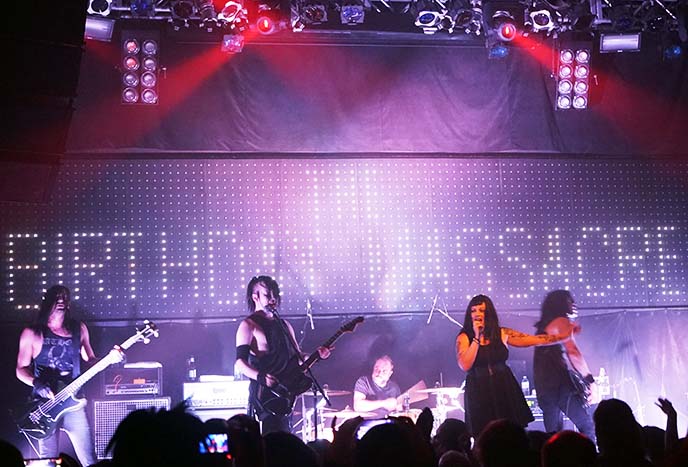
The crowd went crazy when The Birthday Massacre walked on. The Canadian Gothic group formed in 1999, and has cultivated a rabid following ever since.
It seems all my alternative friends have seen them at some point, and continue to love them (myself included). The band’s dark vision yet inclusive, positive energy have made an impact on many growing up Goth.

The dynamic lead singer, Chibi, displayed as much energy as ever. She always gives 100% love to her fans, trading cheeky comments and reaching down to hold their hands.
The band’s name, The Birthday Massacre, perfectly encapsulates front-woman Chibi: cute, chirpy, with a touch of evil.

Any time you see The Birthday Massacre on a concert bill, you know you’ll get a brilliant performance. The musicians displayed their talent through a wide-ranging dark spectrum of sound: electronic, atmospheric, Goth-melodic, headbanging guitar, and the all-mighty keytar.

Michael Rainbow and Chibi are two of original founders (along with Michael Falcore), and you can sense the telepathic connection between them on-stage.
The touring drummer, Nik Pesut, only had two days to learn the songs, and rocked them. Even with a new addition, the live show is as strong as ever.

The Birthday Massacre treated us to two hours of nonstop fun and dancing. They played their most beloved songs, including Blue, Kill the Lights, Looking Glass. Chibi gave a shout-out to a fan celebrating her big day, at the start of the Happy Birthday song.

The group also debuted a few new songs from their upcoming album. I can’t wait for this one: my friend Kevvy Metal (Kevin Maher) worked on the production, and the cover art looks fantastic. The newest songs are on the heavier side, with lots of headbanging riffs.

The band ended with a three-song encore, including a cover of Tiffany’s “I Think We’re Alone Now” that got me cheering. (All right, it’s originally by Tommy James & The Shondells).
The Birthday Massacre put on a brilliant, fan-friendly show as always. Check out their site for upcoming tour dates; this is an act you must see live.

My friends and I were talking about how strange it is to talk about Rose in the past tense… she would have been the first to get tickets for this show.
Still, it feels like she is alongside us, at events like these. In this vein, thought I’d end by sharing some last photos from Kyoto: I took snaps of cute stores that she would have gone wild for.

Rose always wanted to go to Japan, but her health never stabilized to the point where it was possible.
When I saw this collection of cute little seals (San-X Mamegoma toys), I immediately thought of her. She’d run right over to them and give them a squeeze!

Rose loved Halloween everything (like me), and all things kawaii with a touch of weird. She would have swooped up these pumpkin-seal and witch-rabbit hybrids.
This Kyoto portion continues below…
SHARE & COMMENT
What to wear in Greece: Silver Goth babydoll dress! Pi Athens Hotel Suites, Aegean Airlines, Iron Fist Clothing.

“It’s all Greek to me!” Ready for more from travel adventures from Athens?
In my first post, we went on an eye-opening underground, alternative walking tour. This time, I’ll show you where we stayed, and the intriguing architecture found all throughout the city.
There’s no substitute for coming here yourself — but to give you a sense of the experience, Joey Wong shot this travel video about our Athens trip.
Please take a moment to watch the short vlog above, or on @LaCarmina YouTube.

Joey took these images of me on the rooftop of Pi Athens Suites, a newly-opened luxury hotel. From up here, you can see the Acropolis — and the “golden hour” lighting conditions are perfect as the sun is setting.

Outfit details: My silver baby-doll dress is this exact Iron Fist Gothic dress with a skeleton design, and a metallic clutch by Makeup Junkie Bags.
(Shop my style with a click below:)


I know many of you dream of visiting Greece, and have it as a bucket-list destination. Fortunately, it’s easy to get to Athens by flying on Aegean Airlines. Joey flew here from London (where there are three direct flights daily on Aegean), while I came direct from Amsterdam (on their daily flight) — and it only took us a few hours.
Aegean Airlines uses the latest technology to make the journey smooth: if you download the smartphone app, you can check in, download, and access boarding passes even when offline.

I chose a window seat for incredible views during the entire flight. I watched the Mediterranean waters, ancient Athenian ruins, and tiny islands below me… it was better than any in-flight entertainment!
I had an excellent experience flying with Aegean, which goes to more than 30 destinations within Greece. They also serve 145 international destinations in 40 countries, and are an award-winning Star Alliance member.

From the airport, it was only a short drive to Pi Athens / π Hotel, where we were staying. (Address: 4 Fokianou St, Athens, Greece).
I’m all about living like a local, and was glad to see that these suites were in a non-touristic neighborhood. Pi Suites is run by a family, which gives the stay a personal touch. The owner, Sokratis, greeted me warmly, shared his favorite restaurants, and showed me major sites on a map.

He took me up to the fourth floor, and we walked up to the π Terrace. From the hotel’s rooftop, I got a 360 degree, unobstructed view of the Panathenaic Stadium, Acropolis, the National Gardens, Filopapou Hill… a magic moment.

The hotel’s location is ideal — within walking distance of the landmarks, yet in a neighborhood with an authentic, residential feel.
(In the next post, I’ll take you right up to the Parthenon, the iconic temple dedicated to the goddess Athena.)

Sokratis is passionate about interior design, and did all the decor and furnishings himself. The result: Pi Athens’ interiors are modern and luxurious, with bursts of color.
(If you like my Goth metallic fashion, see more below:)

I particularly loved the interior courtyard of Pi Athens, which looks like a picture-window into a dollhouse. Such a cute place to sip coffee and bask in the sunlight, surrounded by greenery.

π Athens only has six rooms, which gives guests the personalized service of a boutique hotel. The rooms are large, and decorated with modernist minimal accents (my favorite type of interior design, as you’ll recall from my apartment tour).
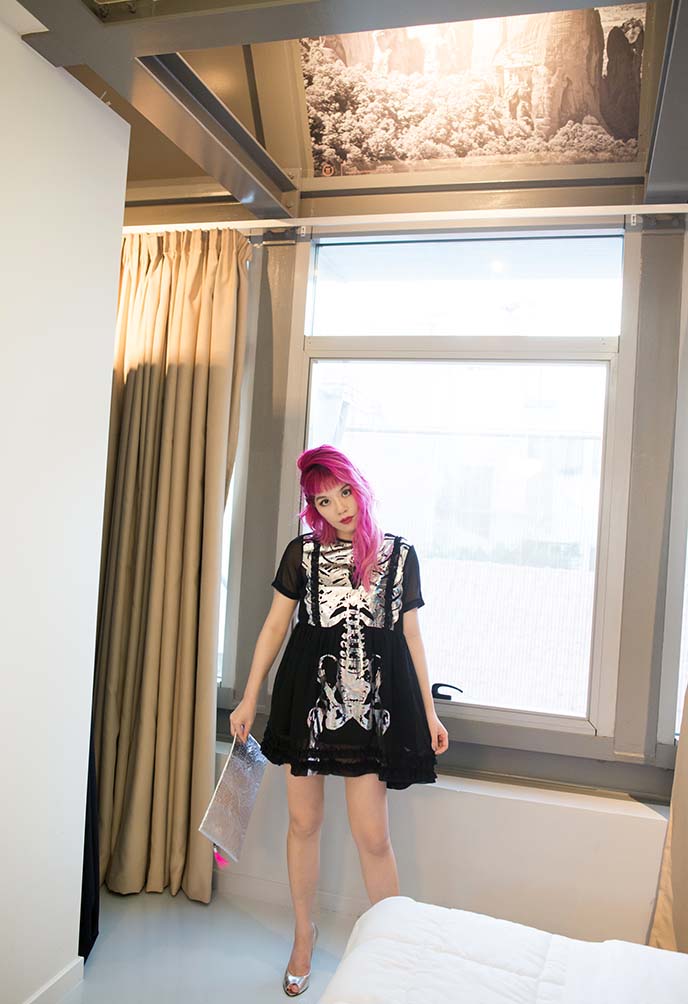
I slept extremely well in this big, fluffy bed…
(Wearing this exact Iron Fist Wishbone Halo dress, silver high heels from my friend Sandi, and a Makeup Junkie bag.)

Every morning, I looked forward to the home-made breakfast downstairs. Fresh orange juice, Greek honey and orange marmalade with zest, and my beloved “dolmades” or seasoned rice wrapped in grape leaves.

Love the architecture of the suites, which take inspiration from pi. π is the Greek letter that symbolizes the ratio of the circle’s circumference to its diameter.
It’s impossible to square the circle (you get 3.1416… to infinity), but Pi Hotel Athens always aims to give guests a 5-star stay.

(My pink hair is by Stephanie Hoy at Sugar Skull Studio in Vancouver. There’s a buzzcut / undercut / hair tattoo in the back, but you can’t see it if my hair is down.)

Our hotel was right by the Panathenaic Stadium, or “Kallimarmaro” (which means “beautiful marble.”) This is the only stadium in the world built exclusively from marble, making it an architectural marvel as well as a historic monument.
You may recognize this Athenian stadium from TV — it’s where the Olympic flame is first lit, before it goes on a journey by foot, all the way to the hosting city.

● Outfit Details ● I’m wearing this Iron Fist Bone faux fur black coat, and metallic skeleton skirt (click the links to get these exact designs). My Ouija board shirt is from Long Clothing, and my fishnet stockings are similar to these.

This landmark dates back to 330 BC, when it was a racecourse established by the Athenian statesman Lycurgus. It was refurbished in the late 19th century, and became the site of the opening and closing ceremonies of the first modern Olympic Games in 1896.
The stadium became an Olympic venue again, when Athens hosted the games in 2004. Today, it remains a popular site for events, and is the finishing point for the yearly Athens Classic Marathon.

I posed like a champion in front of the marble stands. (Although in the days of ancient Greece, Olympic athletes were always male… and they competed nude!)

Classic, timeless architecture. The ancient Greeks were ahead of their time, in so many fields.

From certain angles, the Panathenaic Stadium reminds me of a stark, alien spaceship.

I stopped in front of the massive Greek columns of the Zappeion. Located by the National Gardens, it was built in the 1880s as a fencing hall, for the first modern Olympic games.

Vertical meets horizontal, light and shadow. For architecture buffs like myself, Athens is a joy to explore on foot.

The city’s neighborhoods have very different vibes, ranging from gritty industrial, to romantic Mediterranean. One of my favorite parts of Athens was Monastiraki, in the winding paths near the Acropolis.

Find a local cafe, bask in the sun, sip a coffee or ouzo (Greek anise-flavored liqueur), and dine on orange cake (made with layers of filo, orange zest, and Greek honey)… Zeus, this is heaven.

It’s rather obvious that I’m a fan of Greek food! I could wax on about the incredible dishes we tried in Athens.
I suggest asking locals for recommendations, and dining on traditional fare from the region. Two of my favorite restaurants were Fish Point (8 Archimidous St, Plastira Square, Pagrati) and Seychelles (Kerameikou 49, Athens 104 36). The grilled sardines with fresh lemon, sea bass, cabbage dolmades with herbs, spanokopita (spinach feta and filo pies)… take me back…

And needless to say, Greek olive oil is beyond compare. In addition to eating it with every meal, I found my new favorite bath product: olive oil soap from Korres. This company creates Greek beauty products with natural ingredients like honey and yogurt; I also picked up an avocado face mask that is a winner.

It’s fascinating to see layers of history in Athens, one of the world’s oldest cities. Above is Mitropolis, or Greece Metropolitan Cathedral, built in the late 19th century.

Walk a little more, and you’ll come across the Panaghia Kapnikarea: a Greek Orthodox church, and one of the oldest in the city. This structure dates back to the 11th century, and it was built over an ancient Greek pagan temple dedicated to either the goddess Demeter or Athena. Today, it’s in the center of a busy, modern shopping area!

Ultra modern meets ancient… Athens is one fascinating city.
(All photography by Joey Wong.)

If you’re planning a visit to Greece, check out the Discover Greece portal for lots of helpful travel tips. You’ll find suggestions for every type of traveler, from family hotels to nature excursions to spas.

How are you enjoying my Athens stories and outfits of the day? Wait until you see what I wore to the Parthenon… you can see glimpses of this in our travel video – come watch!
 LA CARMINA


