Noord: a hidden, off-the-beaten-track Amsterdam hipster neighborhood! Eye Film Museum, restaurants, art studios.
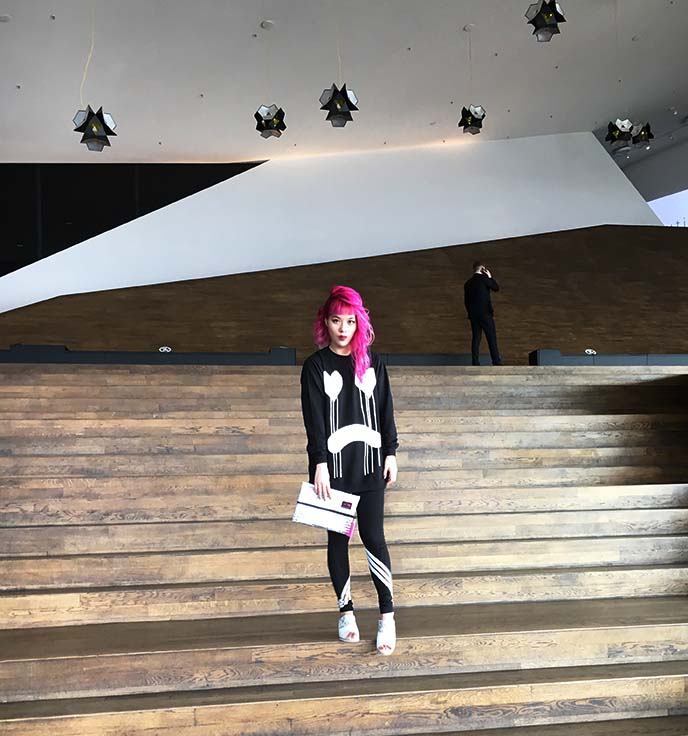
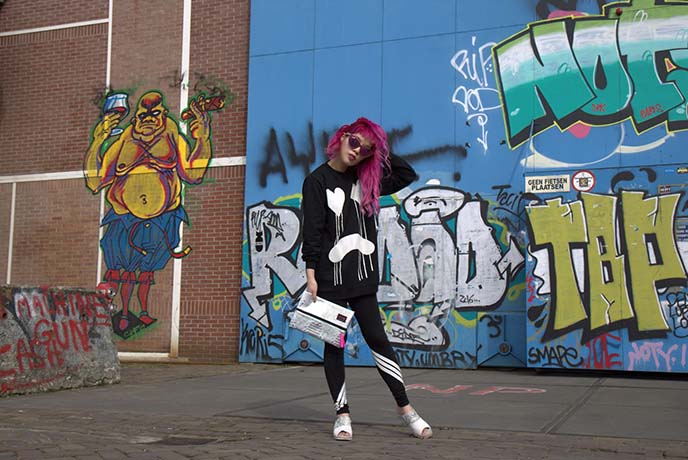
This girl is all smiles (despite what my Long Clothing top says)… because I’ve discovered an Amsterdam district filled with inspiration!
Have you heard of “Noord,” the waterfront area north of the city center? Home to EDM festivals, artist studios, and transformed warehouses, this is a side of Amsterdam that very few tourists see.
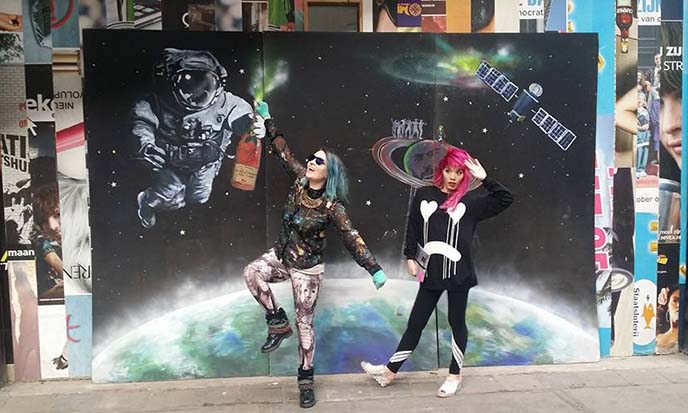
Like intrepid astronauts (or… space cadets), my friends and I will take you to the most cutting-edge hangouts in Noord. It’s incredible to see how these run-down shipyards have been transformed into hipster heaven.
(Above, I’m wearing this Long Clothing Drippy sweatshirt.)

But first, a quick announcement: I had the honor of being interviewed by BBC Radio about Goth lifestyle and culture! The show “talks to Gothic blogger, La Carmina, about the extraordinary and extreme goth scene in Japan that includes body modifications.”
Here’s the link to my BBC Radio Worldwide interview, and you can hear my voice throughout in the entire program for “The Why Factor” show. Thanks everyone for the positive reception so far!
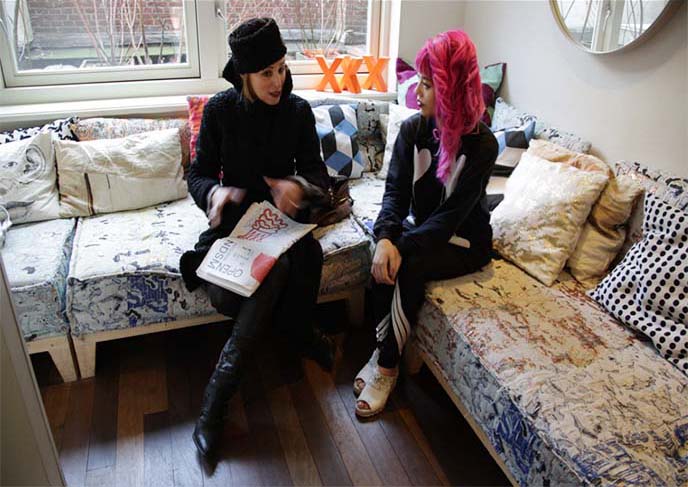
Now, back to Holland. The team at I Amsterdam (the city’s tourism board) matched me with the perfect guide for an insider tour of Noord. I instantly clicked with Faustina, who shared my love of glamorous fashion and cat-eye sunglasses!
She met us at Hotel The Exchange, and did an introduction with maps to get me oriented. (Soon, I’ll take you around this stylish boutique hotel).
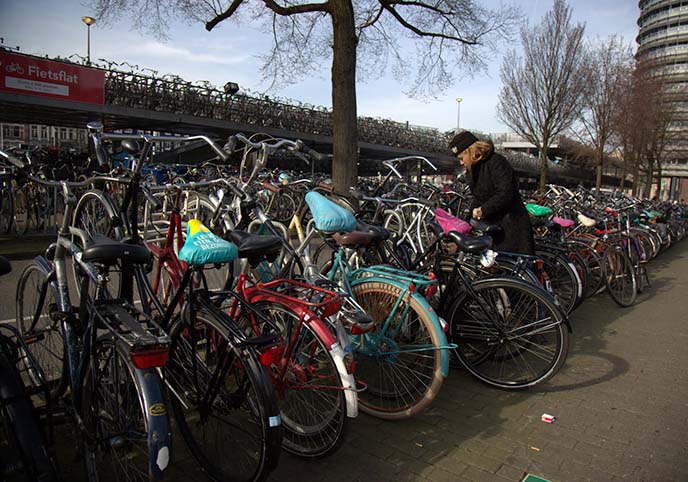
We walked to Centraal Station, where Faustina locked her bike next to literally thousands. Notice the “parking lot” above her, filled to the brim. Amsterdam truly is the city of bicycles.
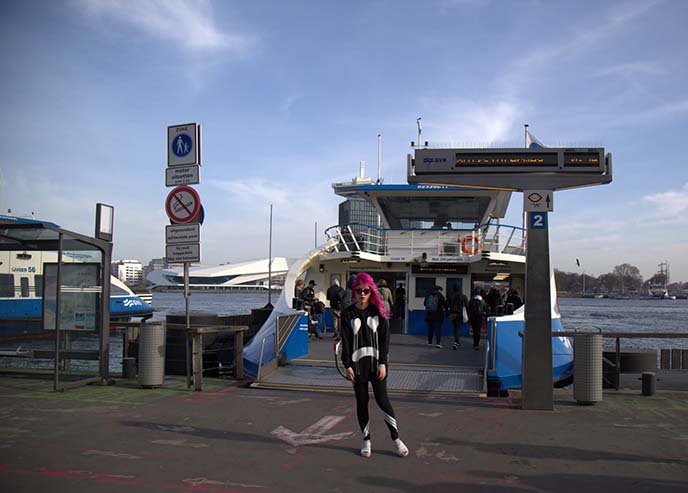
Noord is located only 5 minutes from the central station, making it a convenient yet off-the-beaten-path destination.
Anyone can hop onto the Buiksloterweg ferry. The ride is free, departs every 10 minutes, and can accommodate bicycles and scooters. Before you can figure out how to pronounce the ferry’s name, you’ve crossed IJ Lake and arrived at NDSM wharf.
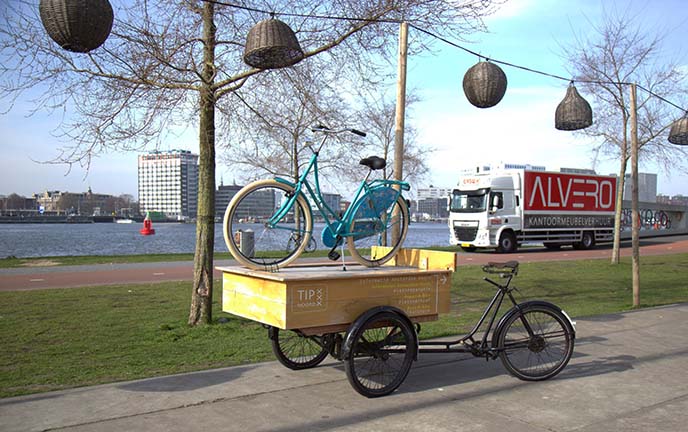
Step off the little ferry, and you’re arrived in northern, uptown Amsterdam. Right away, you can sense that Noord has an artistic, young vibe. (All photography by Arina Dresviannikova)
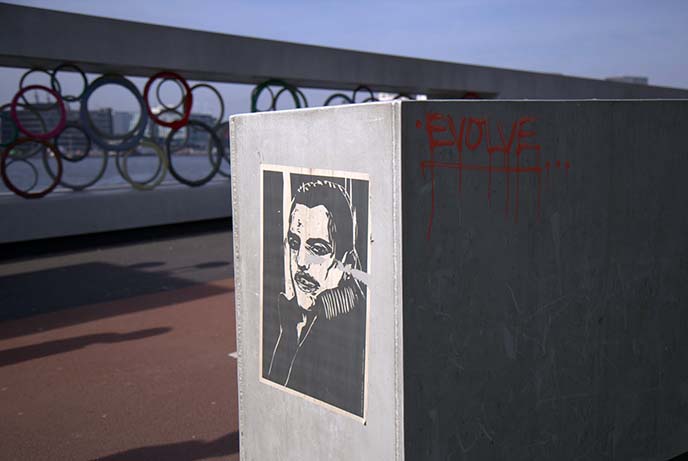
“I see a little silhouette of a man”… that’s the one and only Freddie Mercury, next to a decorative wall overlooking the waters.
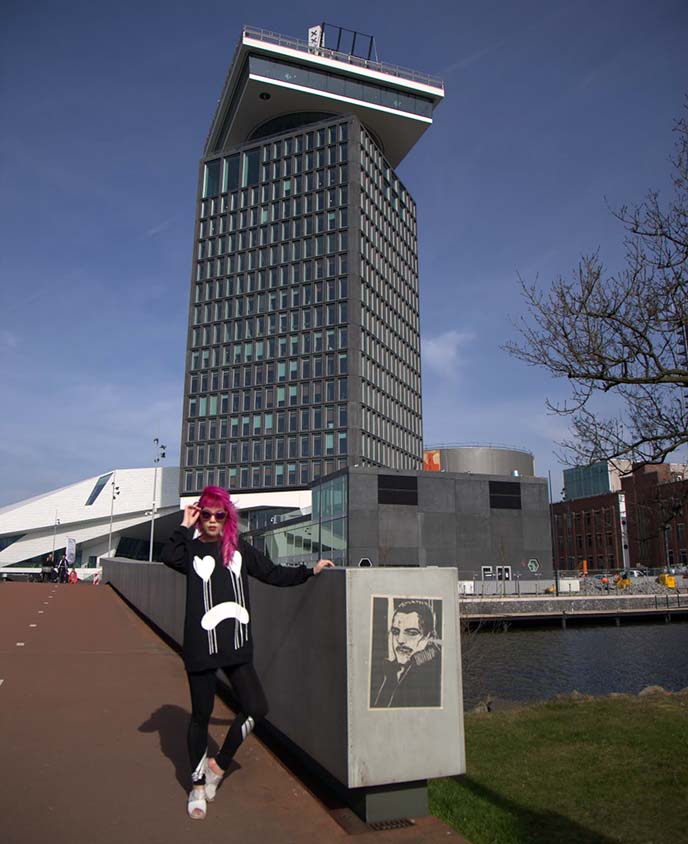
It’s impossible to miss A’DAM Toren, named for “Amsterdam Dance And Music.” This 22-storey tower looks over the waterfront, and was opened by a creative team that includes EDM pioneers.
As you might expect, this is a one-stop place to party. ADAM Tower contains nightclubs, bars, cafes, hotel rooms, and a revolving restaurant (the square-shaped disc at the top rotates around). The top floor has a 360 degree panoramic terrace, and Europe’s highest swing that sends adrenaline junkies “over the edge.”
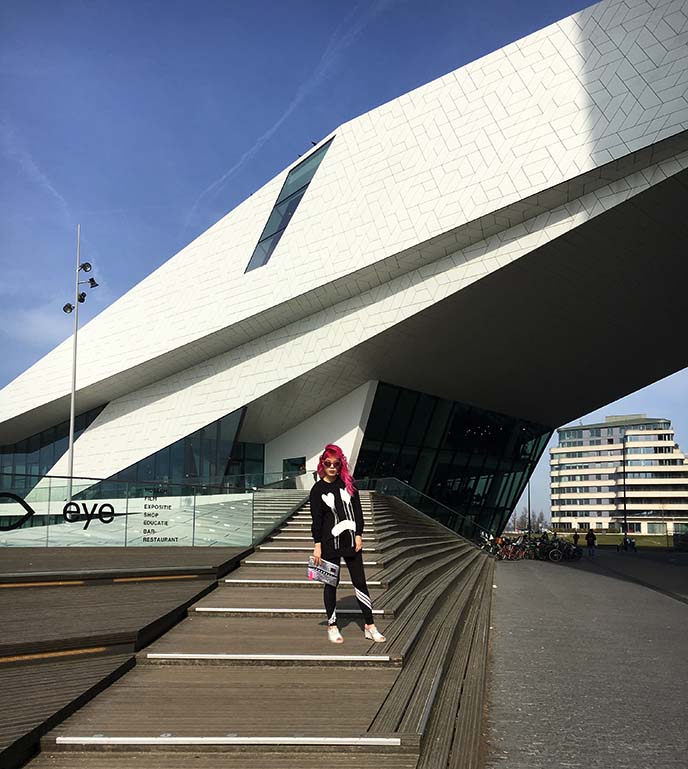
There’s another space-age building nearby: EYE Film Museum.
Named after the river IJ (which is pronounced “eye”), this modern structure is a film buff’s dream. You’ll find four cinemas and a restaurant inside, plus an extensive archive, and rotating exhibitions about filmmakers.
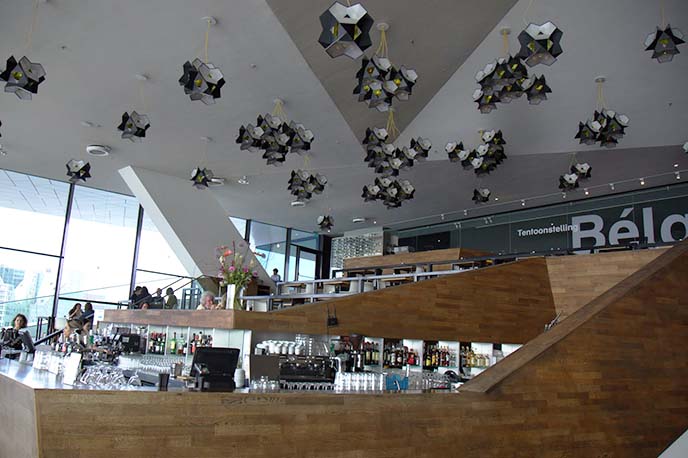
The Eye is the vision of architects Delugan Meissl. Like a projected film, the building seems to be in constant motion. As the designers put it, the concept is a “sustained encounter between urban reality and cinematographic fiction.”
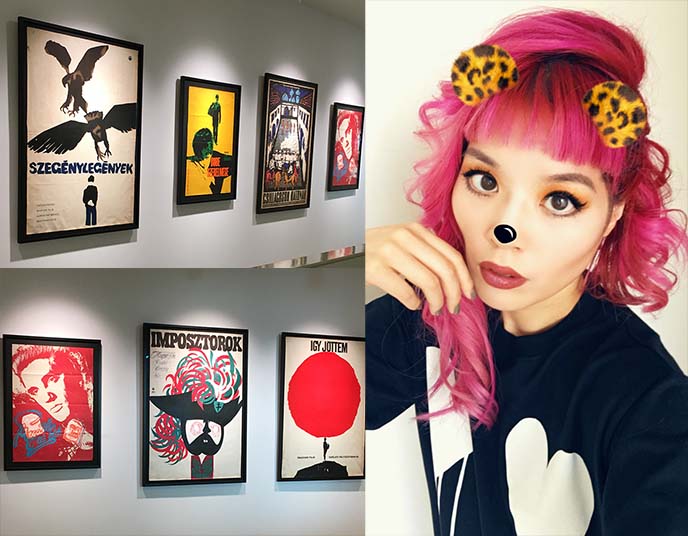
When I visited, EYE Film Museum had a fascinating exhibit dedicated to Hungary’s Bela Tarr, auteur of melancholic films about the human condition.
His films played in sets that re-created his world — including a decaying tree surrounded by barbed wire fences, with leaves blasting though the room. (We weren’t allowed to take pictures inside, so you’ll have to use your imagination — or better yet, visit for yourself).
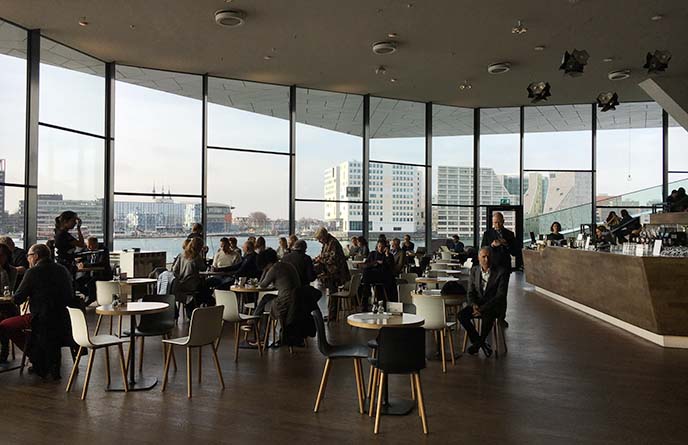
On the ground floor, the Eye has an open-plan cafe with spectacular views of the IJ harbor.
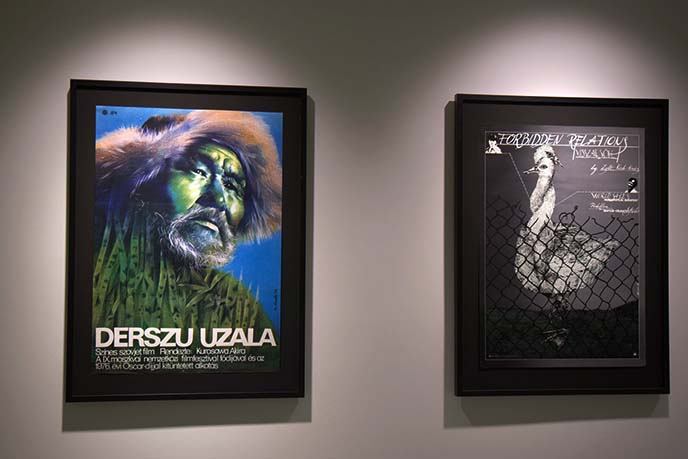
Eye Filmmuseum hosts frequent screenings and lectures. They have an annual Imagine Film Festival, dedicated to exploitation, cult and lower budget films.
Within these walls, there lies an extensive film archive with close to 40,000 Dutch and foreign titles. The collections also include posters, photographs, soundtracks and other archival material: a treasure trove for studies.
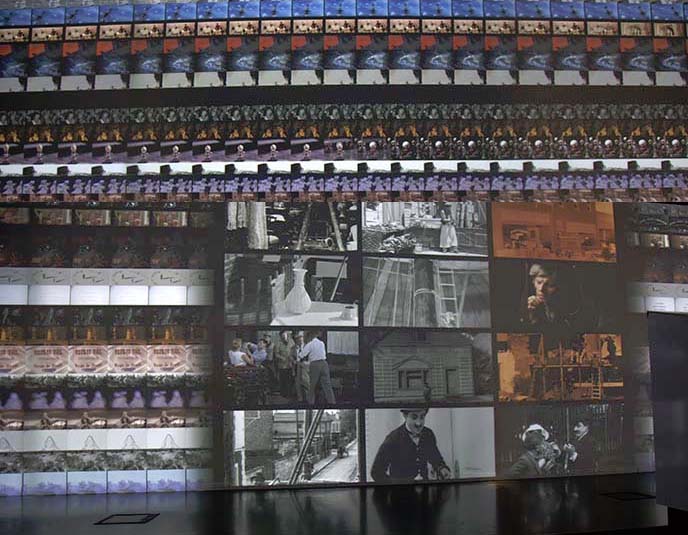
In the lower level, we saw historical cameras, projectors, and clips of Dutch films dating back to the late 19th century. This museum is a must for movie-lovers.
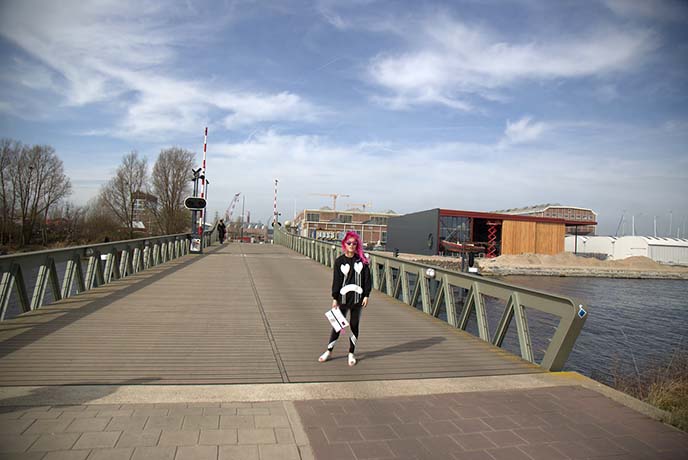
We continued our walk through Noord, and Faustina told us about its history. In the 1600s, sailors and merchants moved to the northern banks, to work in the maritime industry and find affordable housing.
This was a shipbuilding area until the 1980s, when the industry declined. Before long, Noord turned into an industrial wasteland, filled with the ghosts of the past.
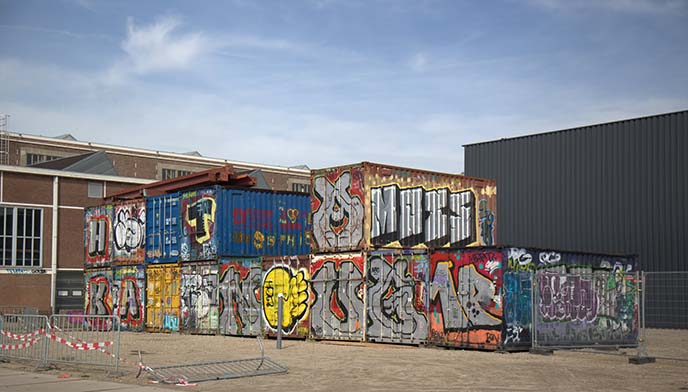
Lured by low rents, artists moved in — followed by creative companies like MTV. They revitalised Noord, transforming these decrepit lots into a graffiti-covered wonderland.
Today, Noord is a lively neighborhood with a diverse population. Many tech startups and artistic firms are headquartered here.
The Netherlands gives generous support to young artists, including providing studios for them to create.
Faustina took is to NDSM Wharf, a giant collective of creative minds. As we approached, the street art grew more and more vivid.
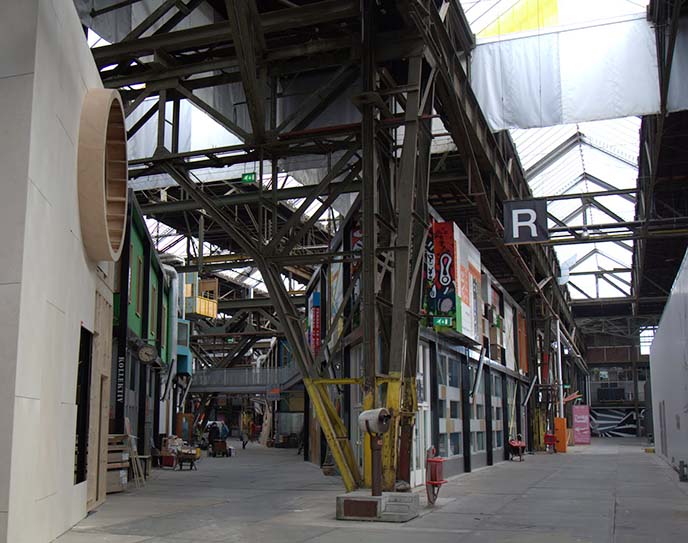
NDSM stands for Nederlands Dok en Scheepsgebouw Maatschappij (Dutch Dock and Shipbuilding Company): one of the largest European shipyards before going bankrupt in 1980.
The abandoned warehouses fell into disrepair, until street artists from around the world turned them into colorful canvases.

We peeked into design studios, and posed in front of this intergalactic mural. There was even a cheeky, hot-pink installation called a “Barbie Peep Show.”
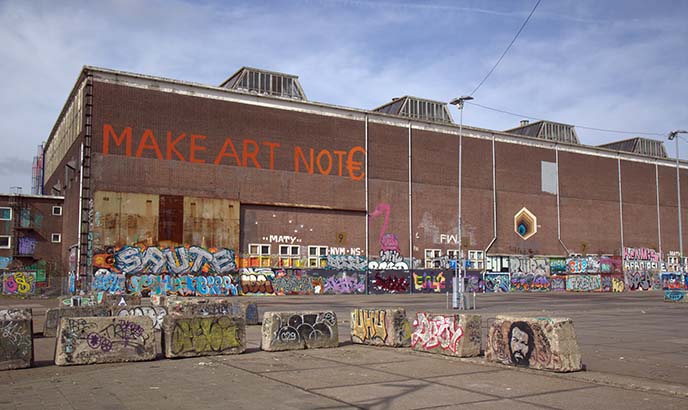
“Make art, not Euros.” That’s the DIY spirit at NDSM.
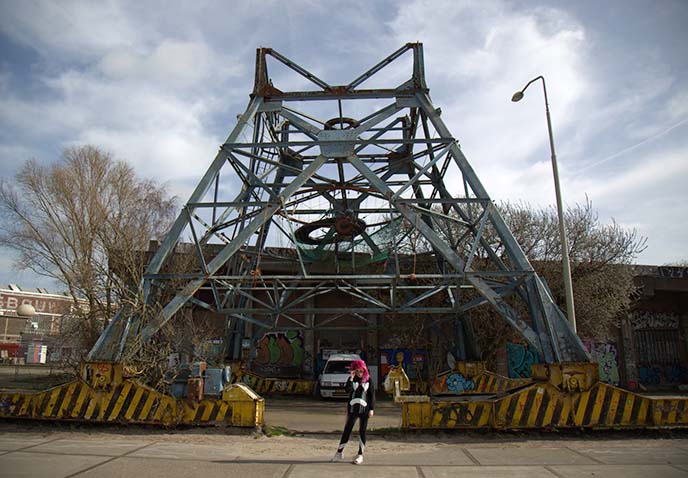
As we kept walking, I was impressed by the myriad of ways that locals turned industrial skeletons into art.
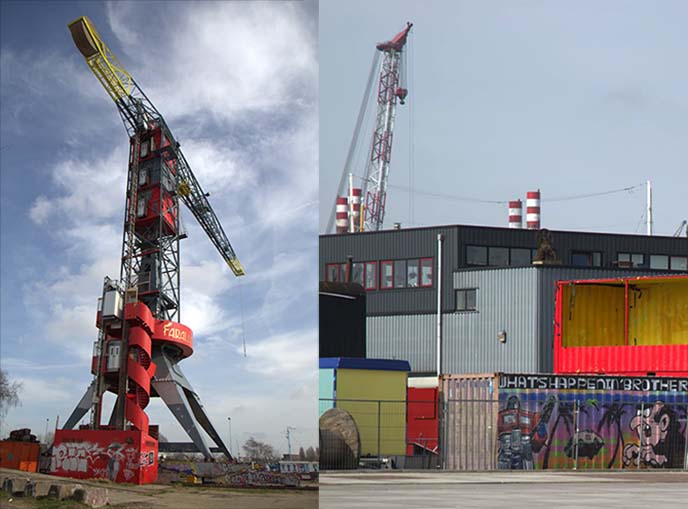
Case in point: Crane Hotel Faralda. In this old shipyard, an abandoned 50-meter-high crane was turned into a three-room boutique hotel!
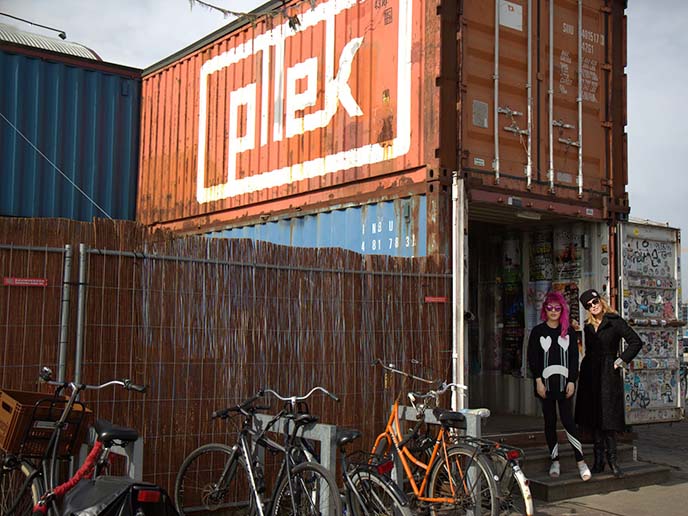
I witnessed one of the coolest transformations at Pllek, a modern restaurant built out of shipping containers. (Address: TT Neveritaweg 59, Amsterdam)
It’s easy to mistake this entrance for a pile of rusting compartments. However, when you walk in, you’ll discover a spacious glass-front eatery by the river.
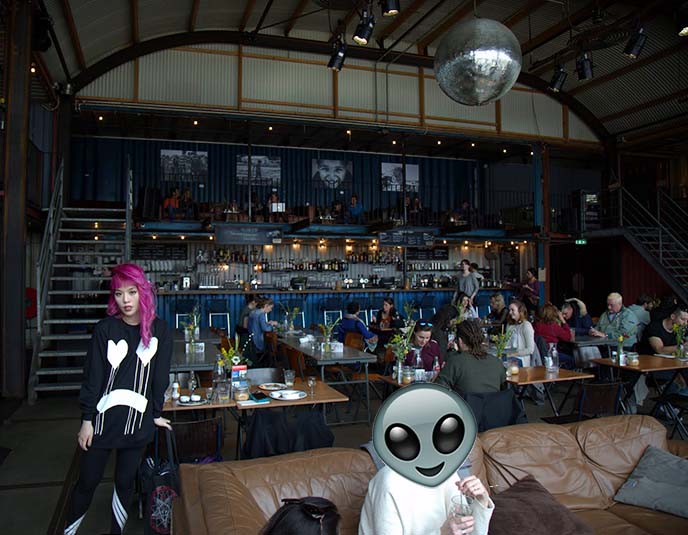
Pllek continues the upcycled theme inside, with furniture made from salvaged maritime artifacts. Concrete floors maintain the industrial feel, while a disco ball adds fabulosity.
The diners tend to be young, hip foodies… an alien would fit right into the picture!
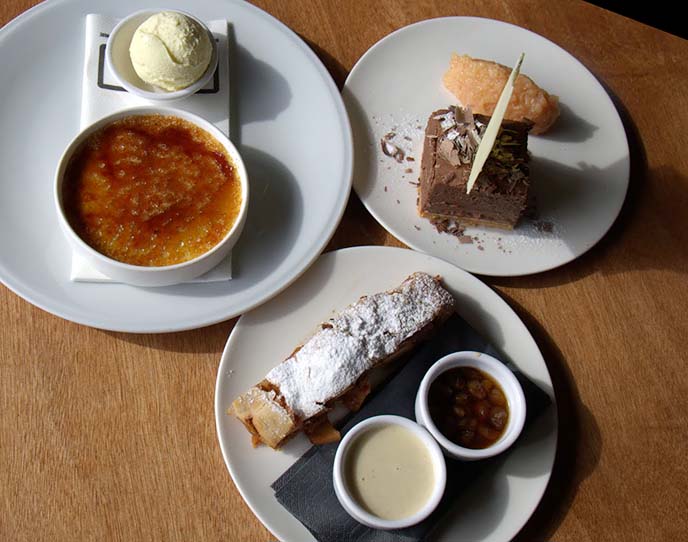
The menu relies on organic, sustainable meats and produce. I ordered a pumpkin ravioli, and it was one of the best meals of the trip.
Desserts are a must at Pllek: Dutch apple pie, creme brule, chocolate cake, ahh.
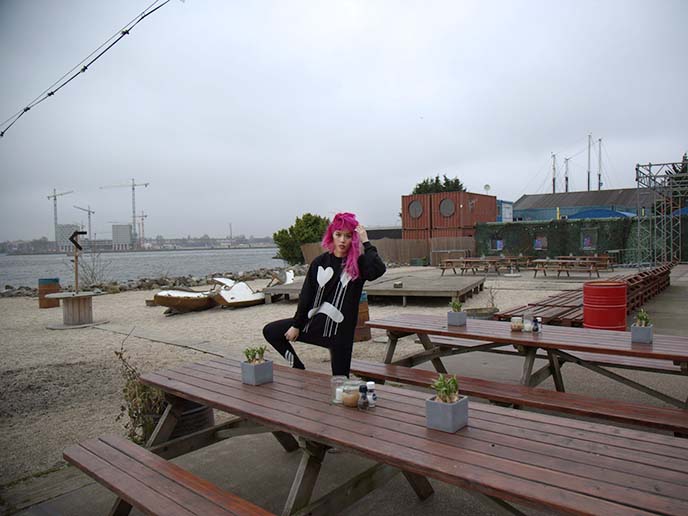
Outside, Pllek has picnic benches and a strip of sand. When the sun shines, this is “the” place to hang out by the river.
Pllek also organises regular cultural events, ranging from photography exhibits to yoga and Tai Chi on the beach. At night, they bring in DJs for some of Amsterdam’s best dance parties.

Back in the city center, I had another spectacular meal at Restaurant Lt. Cornelis (Address: Voetboogstraat 13, Amsterdam).
As you might guess from the “chiaroscuro” portraits, they specialize in traditional Dutch cuisine, prepared with locally sourced ingredients.

However, a peek into the open kitchen, and you’ll see young chefs with tattoos working with flames. Restaurant Cornelis draws from the past, but gives all their dishes a modern flair.

I recommend going for the “Menu Cornelis,” a four-course tasting that will surprise your palate. Each dish also comes perfectly paired with wine.
The friendly servers brought out dishes that I had never tried before, including melt-in-your-mouth bitterballen (Dutch croquettes). Everything was beautifully plated and prepared: highlights included the sustainable sirloin, and a chocolate/citrus/white chocolate dessert with foam.
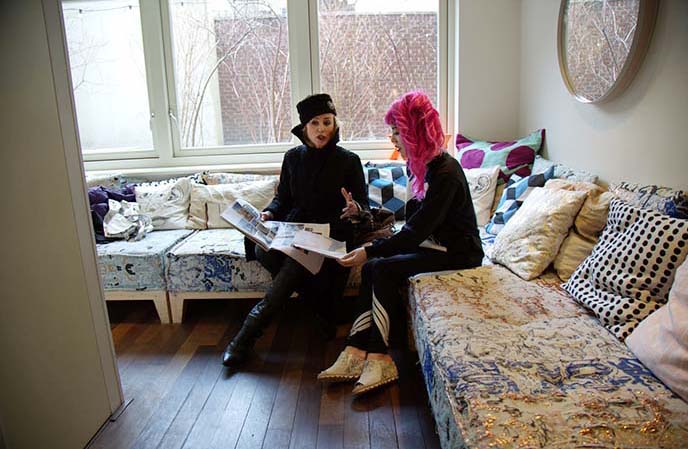
Cheers to all the new friends we made on this journey! I’m glad I got the chance to see the underground, alternative, obscure side of Amsterdam.
If you’re planning a visit, check out the I Amsterdam website. You can find more suggestions for attractions in Noord and other areas.

What’s next… a space-disco journey throughout the galaxy? You’ll have to stay tuned to find out where I’ll be next!
SHARE & COMMENT
We stayed in a Santorini cave with Blue Villas Collection! Ikastikies Suites, luxury villa vacation rentals in Greece.

Ah, take me back to Santorini!
Imagine waking up in a luxurious cave villa… walking out to a private patio with this view of the cliffs… and then digging into a hand-delivered local breakfast.

That was my life for a sweet moment in time, thanks to the outstanding team at Blue Villas Collection!
As you’ll see in this photo diary, they went above and beyond to ensure we had the best possible stay in gorgeous Santorini.

I’ve always wanted to stay in a classic Greek home, but wasn’t sure how to find the right accommodations. Thankfully, Blue Villas works with over 200 luxury rentals on four Greek islands, hand-picking only the best hosts.
My lovely concierge took the time to get to know my interests (modern design, young local culture, photography), and paired me with the perfect Santorini stay — the cave-like Ikastikies Elegant Suites!
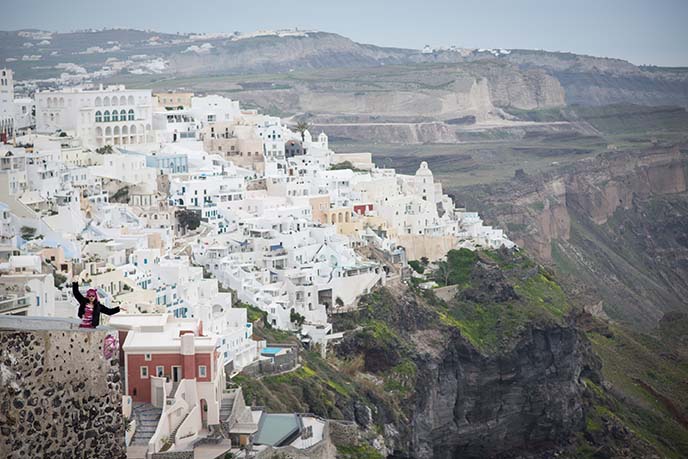
The 5-star service began from the moment we arrived. Our concierge, Amanda, personally picked us up and took us to several insider locations on the island — including a Cretan bakery and scenic spots.
Then, she drove us to Firostefani (north of Fira), and helped us get settled into our dream vacation home. (All photos by Joey Wong).
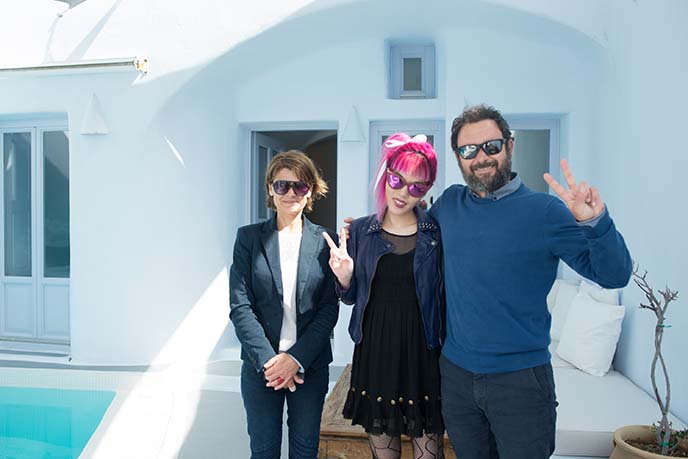
Amanda introduced us to George, owner of Ikastikies Suites. He designed the four villas himself and runs them as a family operation.
As you can see, Blue Villas Collection is all about creating personalized, tailor-made holidays for clients. They gracefully take care of all the logistics, and offer the concierge services of a top hotel.
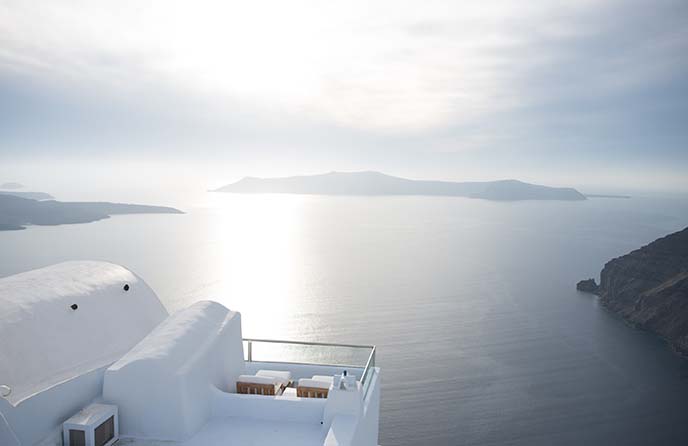
Ikastikies had everything I dreamed of. We had the home to ourselves, with our own private pool, and landing with a brilliant view of the water.

Every morning, I had “me-time” out on the edge, with my cup of coffee. I could look out at the Aegean Sea and cliffs for hours…

… but I loved spending time inside as well, lounging in the fluffy beds and soaking in the giant Jacuzzi bathtub.
The design is a modern take on the island’s traditional cave homes, which were carved into the caldera (volcanic cliffs).
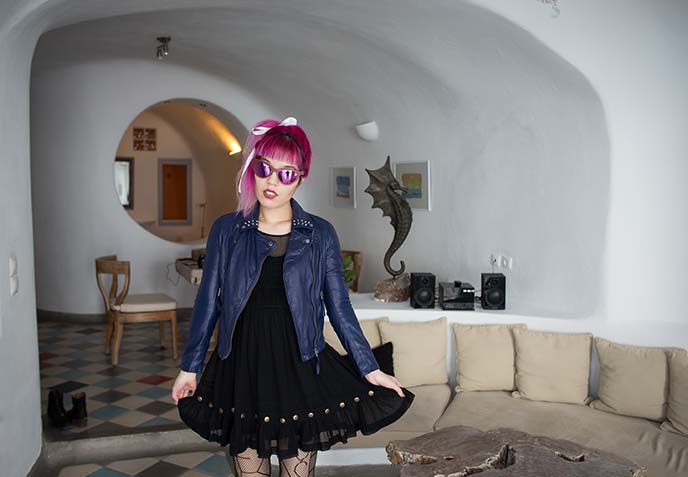
Taking inspiration, Ikastikies Suites feels like a cozy white cave, filled with light. The rooms have elegant curving lines, highlighted with minimalist accents.
Natural accents like the seahorse statue and coffee table add to the Mediterranean island vibe.
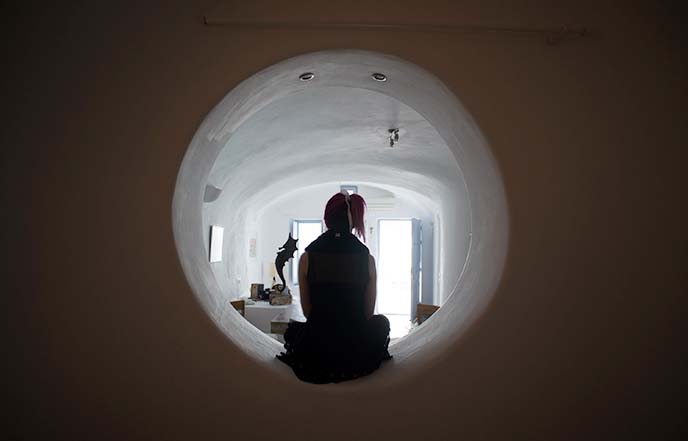
I’ve stayed in a lot of unique boutique hotels worldwide — but this Santorini cave villa captured my imagination!
Every time I woke up and saw this glowing circle next to my bed, I imagined that aliens had transported me to outer space.
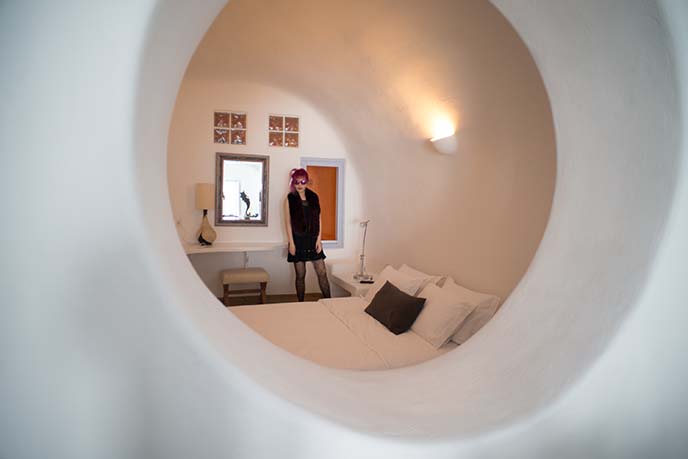
Our Ikastikes cave home had everything we needed for a relaxing holiday, including a full kitchen, two bedrooms and two bathrooms.

I felt utterly relaxed here, thanks to the kindness of George and Amanda. Booking with Blue Villas Collection made our stay far more special than if we had blindly chosen a rental, as their arrangements were tailored exactly to our needs.
Next time I’m in Greece, I’ll be sure to reach out again: BlueVillas has over 200 stunning properties on the Greek islands of Mykonos, Santorini, Paros, and Crete.

Our concierge, Amanda, took care of every detail so that we’d get the most out of our experience.
She knew we loved to shoot travel photos, so she drove us to Santo Winery.

Once again, I got a science-fiction feeling from this door that seems to open into space.

Amanda also suggested that we stop by Perissa Beach, and her recommendation was spot-on. I felt so tiny, standing next to the towering Mesa Vouno rock.

Located on southeast Santorini, Perissa beach features crystalline waters and black sand (quite fitting for a Goth!)
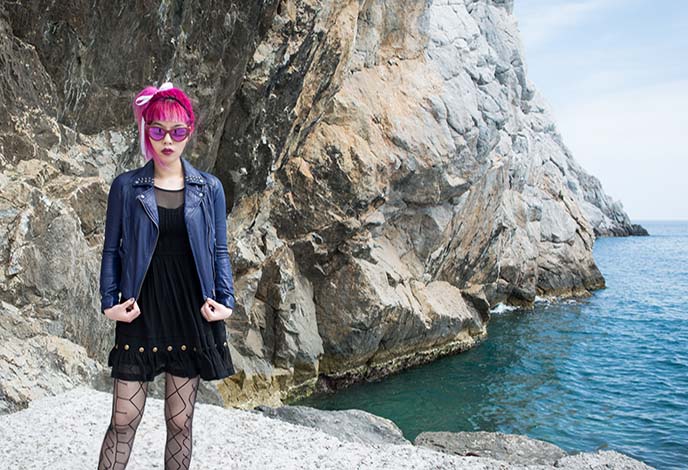
I like to wear outfits that match my destinations: hence the blue clothing, and a white ribbon in my ponytail.
(If you’d like to get your hands on my fishnet tights, they’re for sale on my shop (no need use app, just email me and let me know what I can send you!).

We couldn’t have found a better spot for photos — such an interesting texture on the rock wall, contrasted with the clear waves and dark sand.
Perissa is also one of the best-protected beaches from the wild Aegean winds, as it lies right next to the Profitis Ilias mountain.
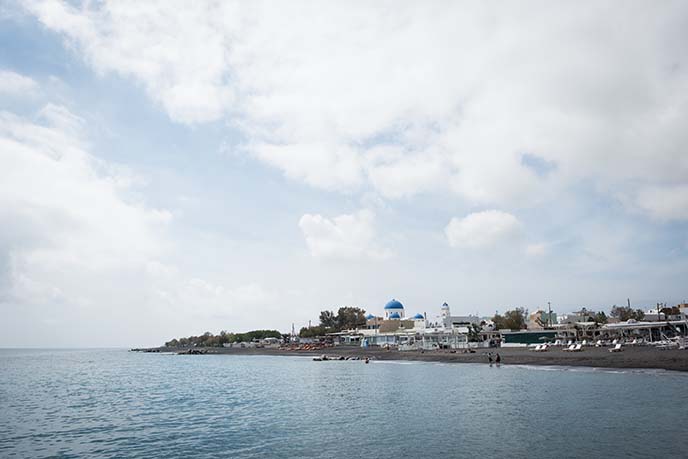
Anyone can come to Santorini’s major beaches for free, and chill on the sand or at the waterfront cafe.
In the distance, you can see the Church of Holy Cross, painted in the traditional Cycladic white with a blue dome.

– I’m wearing hand-crafted wooden sunglasses by Moat House. I get so many compliments on these, and the pink polarized cat-eye frames are made for my face.
– My studded blue leather jacket is one of my wardrobe staples (no, I’m not selling everything I own… only most of it!). It’s from the Bauhaus store in Hong Kong and no longer available, but similar to this Acne blue biker jacket.

Santorini has a bus system that lets you ride to and from the various beaches for less than 2 Euro. However, the locations can be quite spread out, and the public transport routes don’t connect (meaning you’d have to return to the main terminal, then hop onto a different one).
Thanks to Amanda, who guided us around by car, we were able to see several places within a few hours.
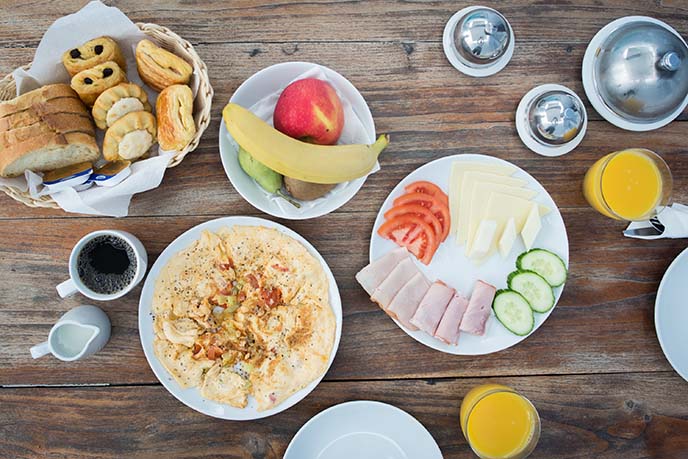
Between excursions, I loved the secluded feeling of our villa. Such a pleasing contrast to a large hotel and group buffet meals.
Every morning, we phoned the Ikatikies Suites staff — and they hand-carried over a tray laden with delights, fresh from the local market and bakery.
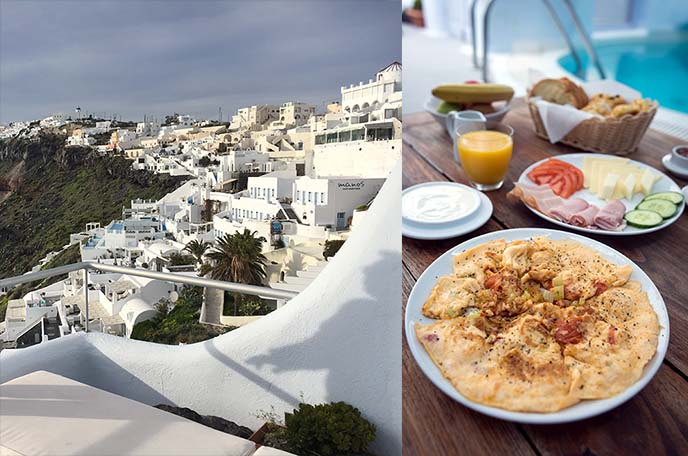
If only I could have breakfast like this every day, enjoying the sunshine and view from the patio.
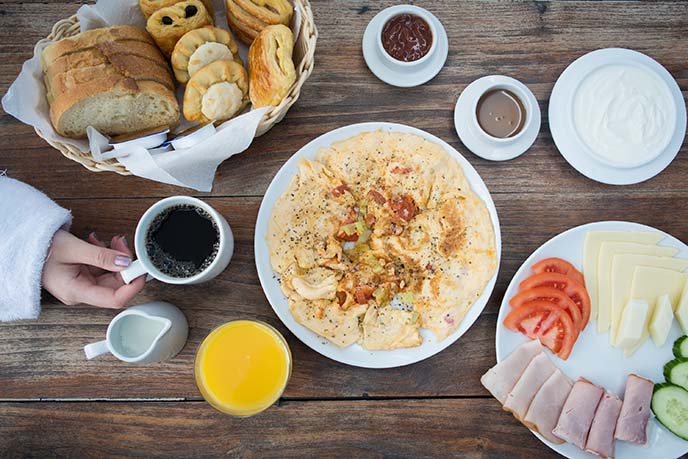
Everything was prepared fresh for us. I ate up every last drop of the Greek yogurt, with local honey and orange marmalade.
Blue Villas can arrange for dinners to be delivered as well, and services such as wellness, gastronomy and sailing.

Joey and I came to Santorini right before the start of the tourist season (late March — most villas and restaurants don’t open til April 1st).
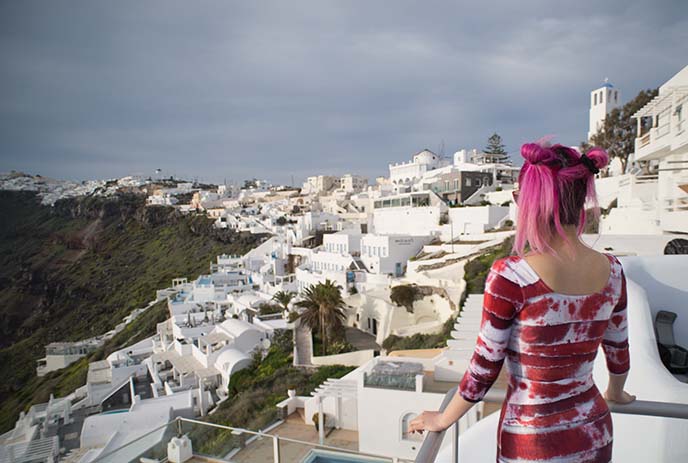
If you’re keen on avoiding the crowds, we recommend coming here in the off-season. The weather can still be a bit cool in late March, but we had clear skies and plenty of sunlight.
The conditions were great for photography; nice to feel as if we were alone on this beautiful Greek island.
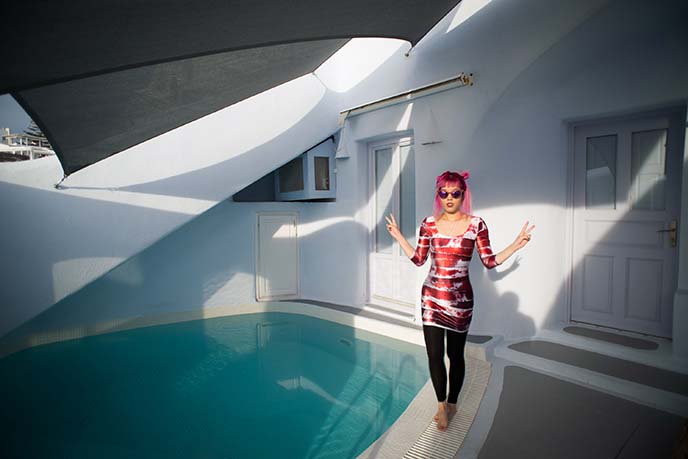
When I first researched villas, I was dismayed to find that many were not open yet (as the season hadn’t started), and that our selection was limited.
Fortunately, Blue Villas Collection took care of us. They have personally vetted over a hundred properties in Santorini, and introduced us to Ikastikies Luxury Suites.
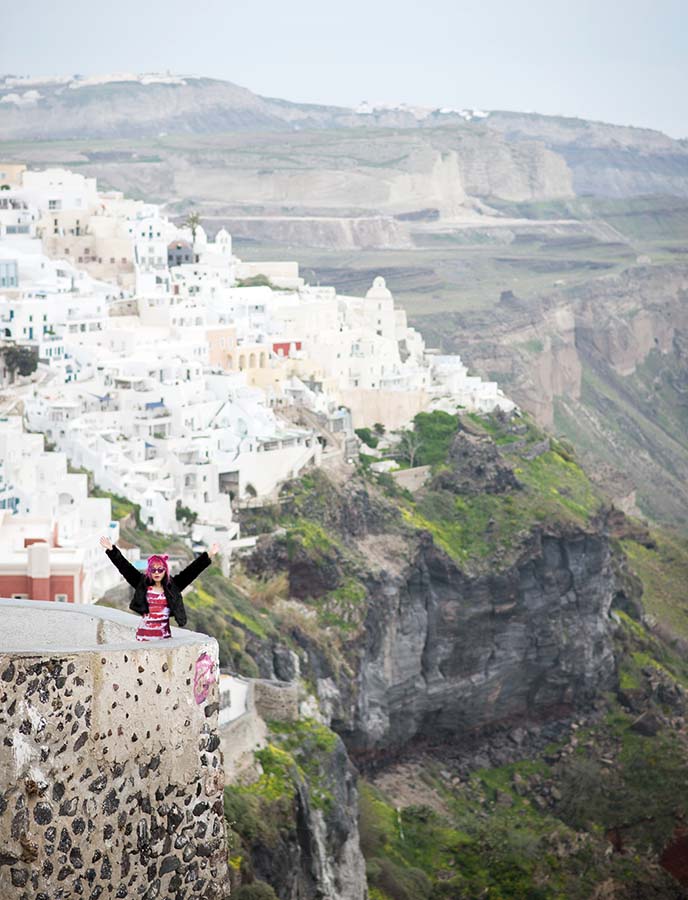
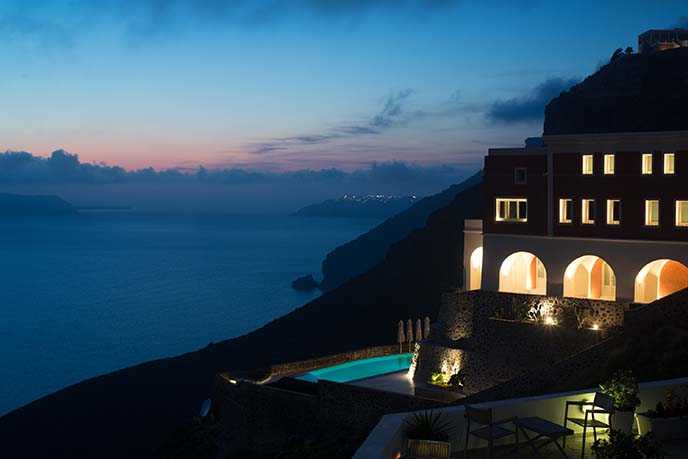
Our villa is located at one of the most beautiful spots on the isle: Firostefani. The quiet village lies between Fira and Imerovigli, and has magnificent views of the Caldera and sunset.
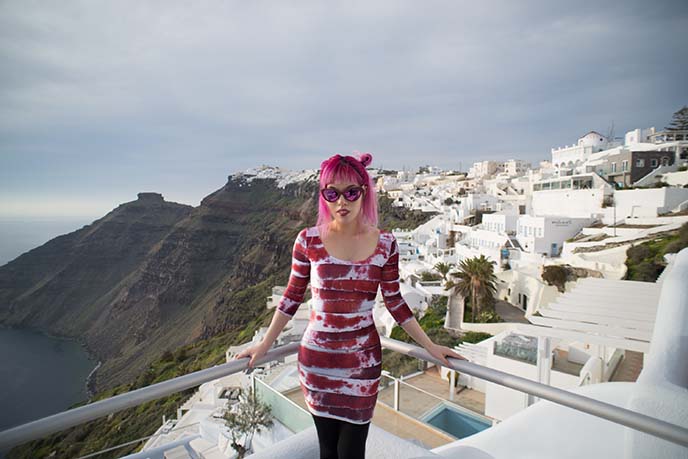
Talk about a picture-perfect patio. (I’m wearing a bleeding mummy bandage dress by Black Milk Clothing — a limited edition Halloween release.)
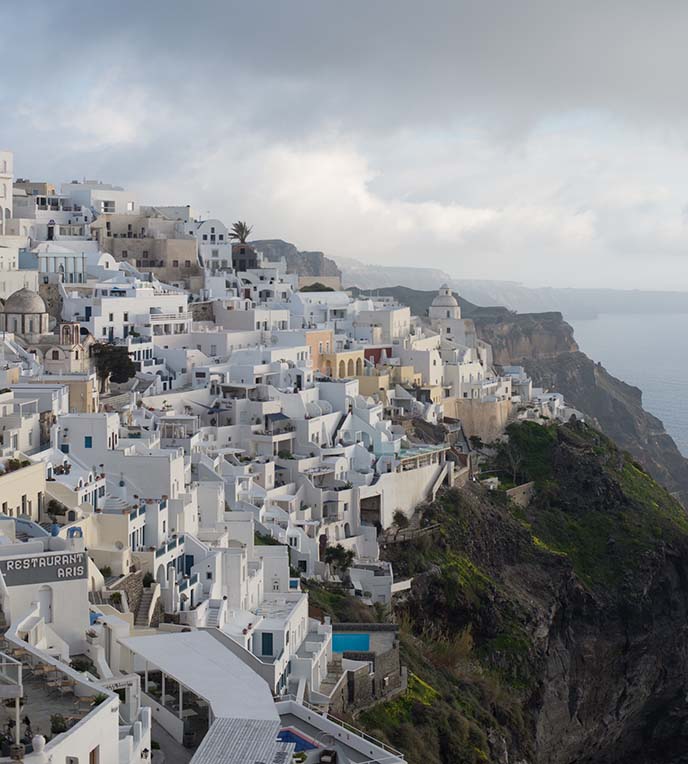
I loved being surrounded by the traditional architecture of Cyclades, characterised by narrow cobblestone paths, whitewashed houses and volcanic cliffs.
Ever wonder why Santorini homes are white, with touches of blue? Historically, locals added a bit of blue to the “sovas” (white layer of plaster) to avoid having it look too bright under the sun. The shades also mimic the Greek flag, and were compulsory during the rule of Metaxas (1936-41).
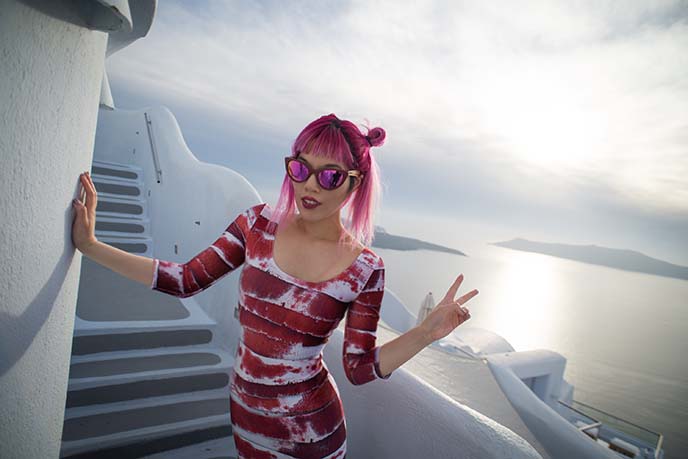
Although the architecture has a historic basis, the effect is ultra-modern, with echoes of the Avant Garde movement and architects like Le Corbusier.
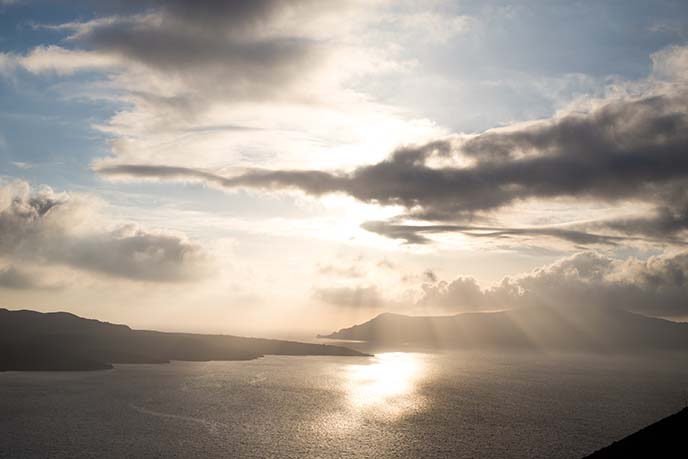
The quality of light is beyond compare. When the sun sets over the Aegean and caldera… ahhh.
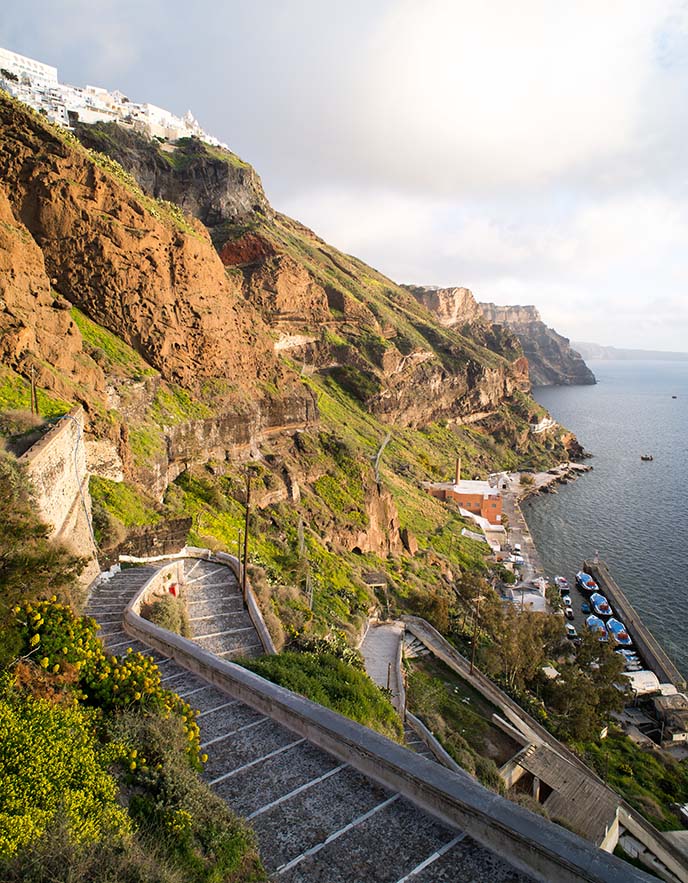
From our villa, it was a short and easy walk to the main village of Fira (or Thera). We often went there for dinner and snacks (try the spanakopita from Svoronos Bakery, and tsipouros anise liquor, sardines and risotto at Tsipouradiko Santorinis).
From Fira, you can also descend the Karavolades Stairs, which take you down the 400 meter high caldera cliffs.
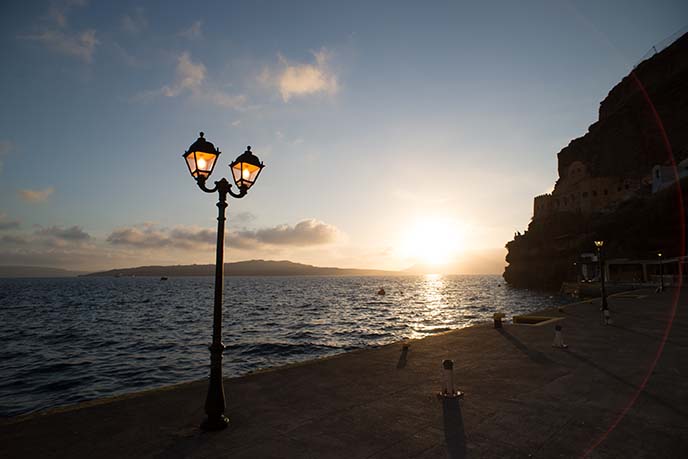
Photographer Joey Wong trekked down the 588 stairs, which opens into the Old Port of Ormos Firon. There’s a cable car option, but it was closed by the time he reached the coast… so he had to walk all the way back up.

If you’re not keen on a “stairmaster” workout, you could also ride up and down the steps on a donkey.
As for me — I descended about halfway, then went back up to eat dark chocolate gelato.
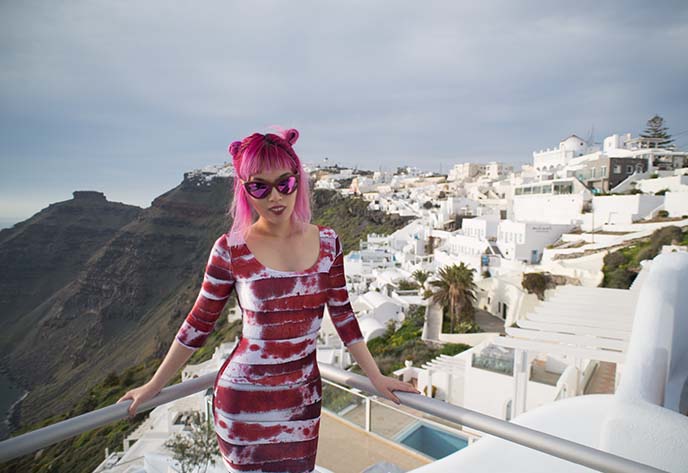
Despite the futuristic feeling, Santorini’s earliest settlements trace back to the middle of the 3rd millennium BC.
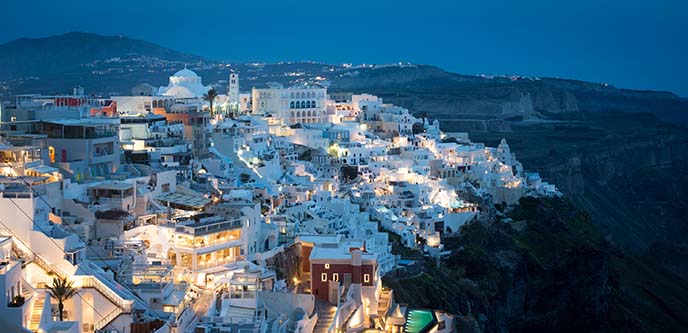
The islanders built their “yposkafos” houses right into the volcanic rock — creating villages nestled into the cliffs. When night falls, the view is mesmerizing.

Santorini has a long history with many different rulers through the ages, including the Phoenicians and Byzantine Empire. The Italians and Germans occupied the island during WWII, and it suffered a devastating earthquake in 1956.
However, from the 1970s onward, Santorini became known as a luxurious getaway spot — and is one of the most popular Greek islands for vacationers today.
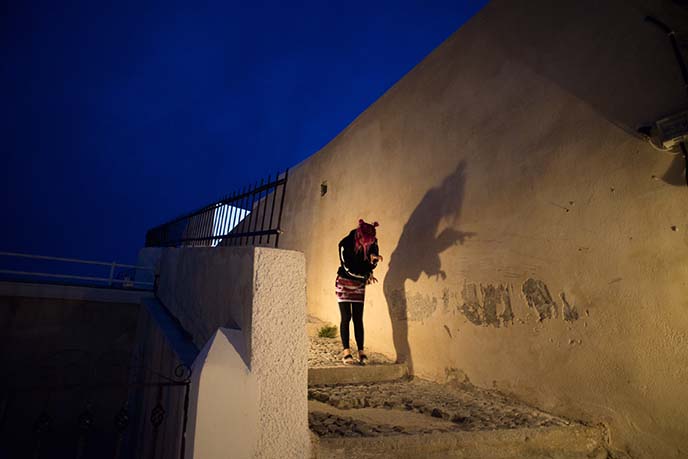
Whether you’re here for a honeymoon, family trip, or Gothic adventures… this island has something for everyone to enjoy.

A million thank yous to Blue Villas Collection, for the sublime hospitality and memories!
Reach out to them if you’re traveling to Greece (Paros, Crete, Mykonos, Santorini), and looking for a perfectly tailored vacation. And check out Ikastikies Suites in Santorini, for a 5-star stay with a friendly owner.
I know I’ll be staying with them again, as I’m keen to see more of Greece. (You can find more info about Athens and other cities at DiscoverGreece.com.)

Is Santorini one of your dream destinations as well?
Coming up soon, I’ll share our sailing trip, and more photoshoots on the beaches!
 LA CARMINA


